… the final, frustrating limit of the pixel itself. We have lived for decades in the subtle tyranny of the pixel, those tiny, glowing squares fighting a constant, losing battle against the curve of the human eye. We accept the screen artifact, the visual compromise inherent in backlighting and light emission, because we have been told this is the digital ceiling.
But the eye knows. The eye always knew. Now, researchers from Chalmers University of Technology, the University of Gothenburg, and Uppsala University have conceived an answer that bypasses the issue of digital reproduction entirely. Not more pixels, but the obliteration of the pixel as we know it.
They call them metapixels, and they are constructed for reflection, not forced illumination.
The material is tungsten oxide, a curious compound capable of switching its molecular identity, moving from being an electrical insulator to a metal. This manipulation of its electrical state allows the metapixels to reflect light in specific, controlled ways, dependent on their size and arrangement. This is structural color, fundamentally; the physics of how light breaks and bends across surface architecture, exactly like the vibrant, shifting hues found on a peacock’s feather or a starling’s wing. It is, perhaps, an odd relief that the most advanced digital breakthrough relies on the same principles that make a magpie shine.
This approach eliminates the historical problems of video pixels shrinking too far—the dreaded color bleeding and the issues with uniformity—because the system does not require a light source.
The resulting screen, the canvas of this new reality, is negligible in size. Approximately 1.4 x 1.9 mm. Smaller than a staple.
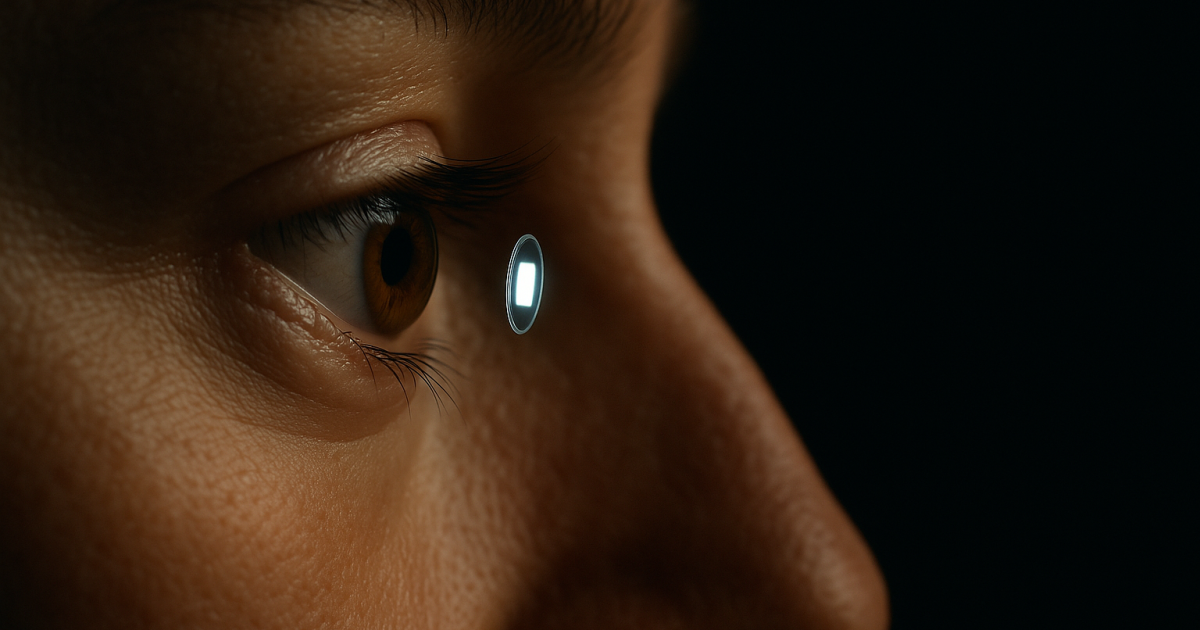
About the size of a human pupil, in fact. This minute window, according to Professor Andreas Dahlin, reaches the absolute biological limit of human perception. “Humans cannot perceive a higher resolution than this,” he insists, noting that each metapixel roughly corresponds to a single photoreceptor in the retina.
Perfect resolution, then. To demonstrate this utter visual indistinguishability, the researchers chose not a spreadsheet or a complex data visualization. They chose Gustav Klimt’s *The Kiss*. That shimmering mosaic of gold, that intense moment of human connection, rendered perfectly, wholly, on a surface 1/4000th the area of a standard smartphone screen.
A perfect, tiny echo of human longing made possible by engineered metallic compounds. Kunli Xiong, the lead author and project conceiver, notes the immediate and practical shift this implies for remote collaboration and scientific endeavor. The aesthetic impossibility leads directly to the practical application.
Highlights of the Metapixel Breakthrough:
* The technology utilizes metapixels constructed from tungsten oxide.
* The material reflects light based on structural arrangement, similar to bird feather pigmentation.
* The screens do not require a light source, eliminating color bleeding issues.
* Screen size is approximately 1.4 x 1.9 mm, roughly the size of a human pupil.
* The resolution matches the capacity of a single photoreceptor in the human retina.
* The artwork reproduced to demonstrate efficacy was Gustav Klimt’s *The Kiss*.
The proliferation of advanced display screen technology has been a hallmark of modern —, transforming the way we interact with information and each other. These sleek, high-resolution screens have become ubiquitous, adorning everything from smartphones and laptops to televisions and public installations. As we gaze into their glowing depths, it’s easy to take for granted the intricate dance of pixels and light that brings images to —. But beneath the surface of these displays lies a complex interplay of materials and engineering.
The latest advancements in screen technology have yielded remarkable improvements in color accuracy, contrast, and brightness.
For instance, OLED (Organic Light-Emitting Diode) displays have revolutionized the way we experience visuals, offering a level of depth and nuance that was previously unimaginable. Meanwhile, innovations in LED and microLED technology have enabled the creation of screens that are not only more vibrant but also more energy-efficient. As we continue to push the boundaries of what’s possible with display technology, it’s clear that the impact will be felt far beyond the realm of entertainment.
From enhancing our daily commutes with augmented reality displays to enabling new forms of interactive storytelling, the possibilities are endless.
According to a report by New Atlas, which provided details on the latest developments in this field, the future of display technology holds much promise, ← →
●●● ●●●
In what could be an industry shifting breakthrough, researchers have created a screen about the size of a human pupil with a resolution that breaks …
Related perspectives: Visit website
 Unknown System Detected